
Yalidy Matos, PhD writes about immigration politics in the United States, Latina/o/x racial identity, Dominican American political incorporation, and women of color political representation. She is the author of Moral and Immoral Whiteness in Immigration Politics (Oxford University Press 2023).
2023
Book: Moral and Immoral Whiteness in Immigration Politics
Oxford University Press
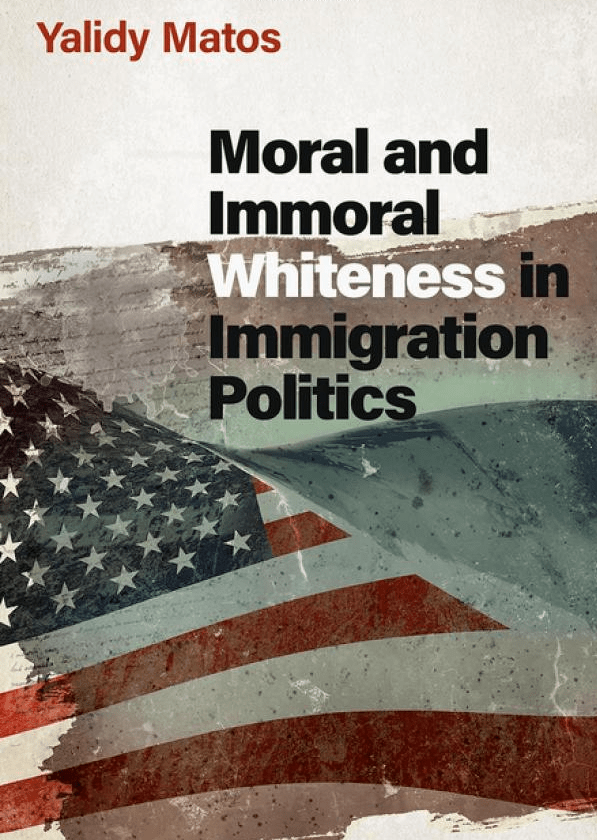
Immigration has been at the heart of US politics for centuries. In Moral and Immoral Whiteness in Immigration Politics, Yalidy Matos examines the inherent moral, value-based, nature of white Americans’ immigration attitudes, including preferences on local immigration enforcement programs, federal immigration policy, and levels of legal immigration allowed. Does identifying as white always signify a commitment to maintain the racial status quo or can it result in commitments to racial justice? How do we understand the passage of state-level sanctuary and anti-sanctuary immigration legislation through a white identity political lens? Thinking about whiteness as a moral choice complicates the idea that immigration policy preferences are mostly about demographic shifts.
To examine the centrality of morality in white Americans’ immigration attitudes, Matos looks at public opinion survey data as well as the roll call votes of elected officials. She examines the conditions under which white Americans choose to reproduce a system structured on white supremacy or repudiate it, as well as the role of socialization in their choices and immigration attitudes. As immigration continues to be weaponized to divide, Matos highlights the importance of understanding the roots of immigration attitudes in the United States and the ways in which whiteness structures these attitudes.
2023
The politics of “women of color”: a group identity worth investigating
By Yalidy Matos, Stacey Greene, and Kira Sanbonmatsu, a peer reviewed article in Politics, Groups, and Identities (PGI), volume 11, number 13, pages 549-570
The political term “women of color” (WOC) emerged in the late 1970s in Black feminist organizing spaces as a rejection of a singular emphasis on a woman identity. At that time, a WOC identity signaled a political commitment to solidarity politics. Currently, the term “women of color” (WOC) is used by the media and among politicians but without much explicit discussion of its history. Given WOC’s continued presence in American politics, the question remains, who identifies as a WOC today and does the identity continue to hold political meaning? We examine Black women and Latinas and find the majority of Latinas and Black women self-identify as WOC and see it as an important part of their identity. Consistent with our expectations, the WOC identity is more likely to be taken up and regarded as important by native-born Latinas and Afro-Latinas compared with other Latinas. While past research has examined racial and gender consciousness, ours is the first public opinion study to examine whether there is continued utility in a WOC identity.
2022
Dominican Political Incorporation in the United States
By Yalidy Matos and Domingo Morel, a peer reviewed article in Latino Studies, volume 20, number 1, pages 67-93
Dominicans represent one of the largest and fastest growing Latino groups in the United States. Since 1990, the Dominican population in the United States has more than tripled, from 517,000 to nearly two million in 2019, becoming the country’s fifth-largest Latino group. As the Dominican population grows, the number of Dominican elected officials has also grown. However, although Dominicans have been elected to political office in New York, New Jersey, and Rhode Island, Dominicans have amassed very little political representation in South Florida, home to the third-largest Dominican population in the United States. In this article we examine the Dominican communities in Washington Heights/Inwood, New York City; Providence, Rhode Island; and Miami/Miami-Dade, Florida, to examine the factors that influence Dominican political incorporation in the United States. Our findings show that the interaction of population size, institutional context, and civic organizations plays a significant role in shaping Dominican political incorporation.
2021
The “American DREAM”: Understanding White American Support for the DREAM Act and Punitive Immigration Policies
By Yalidy Matos, a peer reviewed article in Perspectives on Politics, volume 19, number 2, pages 422-441
The American public has overwhelmingly supported the Development, Relief, and Education for Alien Minors (DREAM) Act since 2001. The support is widespread and cuts across race, ethnic, and party lines. Given the United States’ anti-immigrant/immigration sentiment in the wake of the September 11, 2001 terrorist attacks, support for the DREAM Act is perplexing. To that end, political scientists, sociologists, and education scholars, among others, have pointed to the exceptional framing of the DREAM Act as the primary predictor of support. However, a significant portion of non-Hispanic white Americans who support the DREAM Act also support restrictive and often punitive immigration policies. What influences most white Americans to support DREAM Act legislation? And what leads a subset of these same individuals to simultaneously support restrictive immigration policies that hurt DREAMers and their families? I argue that predispositions explain these two contradictory policy preferences. Data from the 2012 American National Election Studies (ANES) and the 2018 Cooperative Congressional Election Studies (CCES) demonstrates that white Americans use racial resentment and egalitarianism as justifications to support both policies. However, the effects are conditioned on partisanship.
 Yalidy Matos